 Skip to main content
Summary
Phone trees make parkers yell “representative.” Here’s how modern voice AI for parking understands real questions and answers them with your own rules.
Table of Contents
- Press One for Frustration
- What Modern Voice AI for Parking Actually Does
- The Hardest Part: Knowing When You’re Done Talking
- What Happens in the Seconds After You Stop Talking
- Testing Before Launch, Checking After Every Call
- Built on the Same Data Your Team Already Uses
- More Than Permit Questions
- The Takeaway: Call Your Own Line
- James Paden
You have a simple question.
You’re starting school on August 30th, and you need a parking permit. So, you call the university.
“For permits, press two.”
You press two. Then three. Then you’re somewhere you didn’t mean to be, listening to office hours you didn’t ask for. Thus, you do what everyone does. You start saying “representative” louder and louder until something happens.
Sound familiar?
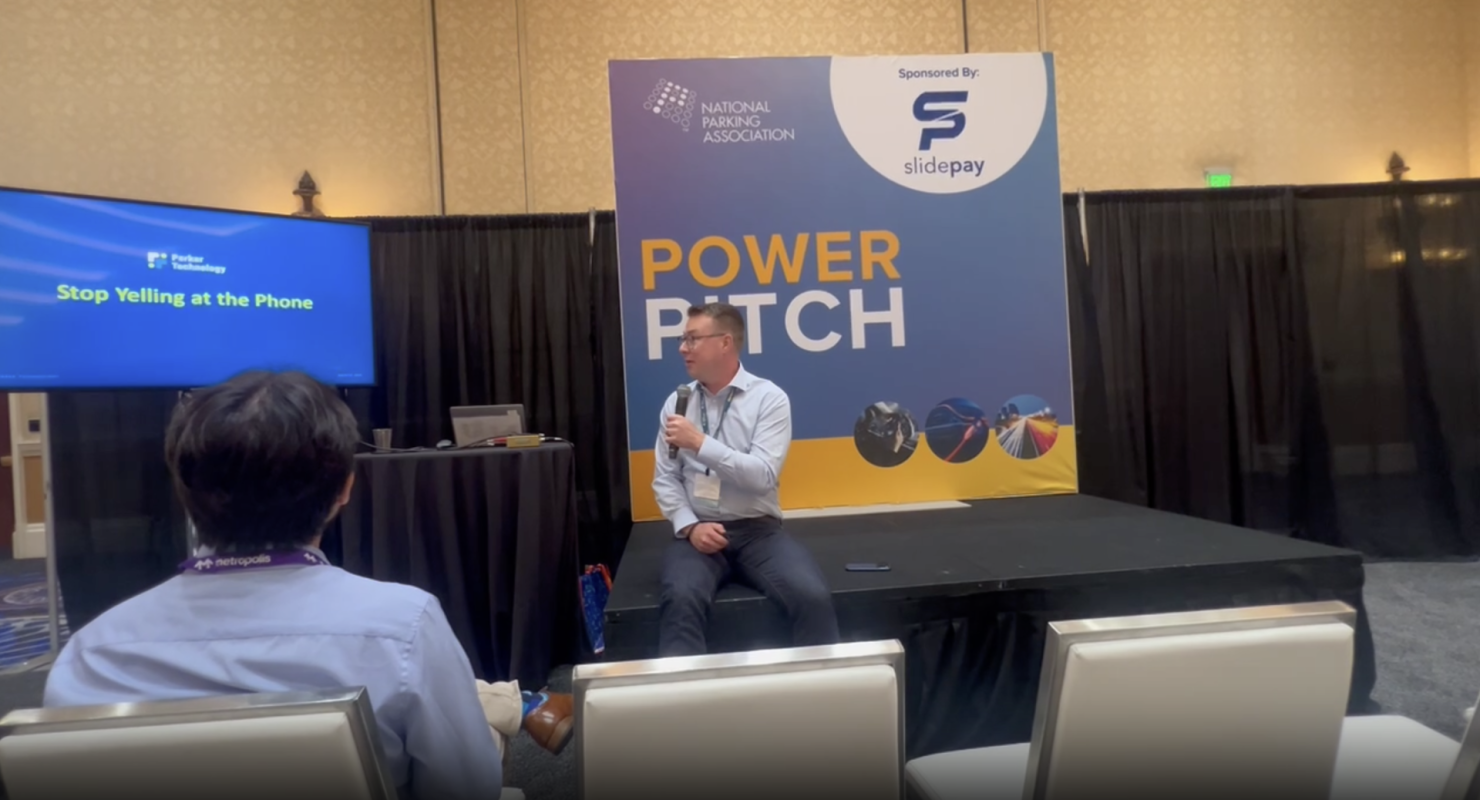
At NPA 2026, James Paden, CPO of Parker Technology, took the stage for a quick Power Pitch with one goal: helping callers “stop yelling at your phone.” With over 13 million parking calls answered on our platform, Parker Technology knows a thing or two about what gets people there. James broke down how voice AI works in a parking context and why it feels so different on the other end of the line.
Press One for Frustration
Most of us know the old-school phone tree by heart. Someone builds a workflow ahead of time. You press one, two, or three to move through it. Every path is set in advance.
A few years ago, phone trees got an upgrade. Now you could say “sales” or “service” instead of pressing a number. Better? A little.
But it was still a tree.
It was still rigid. You still had to go step-by-step. And if you landed in the wrong spot, you had to climb all the way back and start over.
Now think about who’s calling your facility. A student on move-in week. A commuter who parks twice a week and wants to know what a permit costs. A visitor who’s stuck at the gate. None of them want to learn your menu. They want an answer.
What Modern Voice AI for Parking Actually Does
Modern voice AI is built from the ground up in a new way. At the center is a large language model that understands natural speech.
Here’s the key part. It understands both sides of the conversation.
It understands the caller who says, “I’m starting school on August 30th. How do I buy a permit?”
And it understands your side, too. Your rules. Your operations. Which permits you sell, and when they go on sale.
Because it knows both, it can simply answer the question. The caller asks once and gets what they called for.
The Hardest Part: Knowing When You’re Done Talking
Here’s something most people never think about. According to James, one of the hardest parts of voice AI is figuring out when the caller has finished speaking.
That’s tough anywhere. It’s even tougher in a parking garage.
Garages are loud. Cars, echoes, wind, engines. The AI must pick out your voice from all that noise. Then it has to tell the difference between a pause, an “um,” and you actually being done.
Get it wrong, and the AI cuts you off. Or it sits there in awkward silence. Either way, the caller gets annoyed fast.
Before anything else happens, the audio gets cleaned up, and the system works out when it’s truly its turn to talk.
What Happens in the Seconds After You Stop Talking
Once you’re done, a lot happens very quickly:
- Your speech turns into text.
- That text goes to a large language model.
- The system looks up the data and rules that apply to your question.
- It builds the answer and turns it back into audio.
- You hear the answer.
That lookup happens fresh on every single call. There’s no rigid path to follow. The answer comes from your question and your information, each time.
Testing Before Launch, Checking After Every Call
A good voice AI agent doesn’t just go live and hope for the best.
Before launching, we ran our AI agent through a wide range of scenario testing. After every call, the system reviews what happened. Did it do the right thing? Was it fast enough? Were there any mistakes along the way?
That kind of review matters. One wrong answer about a permit deadline or a rate can turn into a frustrated parker, a refund request, or a complaint that lands on your desk.
Built on the Same Data Your Team Already Uses
Here’s the piece that ties it all together. Our voice AI agent, Ambassador, runs on the same data layer that our people already use today.
Rules. Policies. Permits. Slots. Hours. All of it.
That means the AI, and the humans on your team, are working from the same playbook. The information a CSR uses to help a caller is the same information the AI uses to answer. And if the answer isn’t there, the AI doesn’t guess. It hands the call to a person.
Some lines stay firm, too. Even with experience from millions of calls, we still don’t let AI open a gate. As James put it, the data hasn’t earned it yet.
That’s the human + technology partnership in action. The tech handles everyday questions with speed. Your people stay focused on the moments that need them most.
More Than Permit Questions
Permits are just the start. Modern voice AI can handle the calls that pile up at your front desk every day:
- Parking: availability, rates and payments, permits, citations, validations, and garage access
- Directions & Wayfinding: building entrances, office locations, visitor access, campus navigation, terminal information, and department directories
- Office Calls: office hours, building amenities, tenant information, deliveries, and services and support
- Billing & Payments: payment options, refund requests, invoice questions, billing disputes, and payment portals
How many of those did your team answer this week? How many times each?
The Takeaway: Call Your Own Line
Want to know if your phone experience is helping or hurting? Try this.
Call your own number. Ask a real question, the way a parker would. “What does a permit cost if I park twice a week?”
Count how many buttons you press. Count how long it takes. Notice whether you ever feel the urge to yell.
If the answer is yes, your callers feel it too.
Modern voice AI for parking can meet people where they are, in their own words, with answers pulled from your rules. If you’re ready to see what that looks like for your operation, the Parker Technology team would love to talk.

James Paden
CPO
James Paden is the Chief Product Officer at Parker Technology, where he leads product strategy and innovation – including the development of Ambassador, Parker’s new Voice AI Agent. He brings 25 years of software development and product experience to the role, with a track record of identifying emerging technologies and building products that stick.